
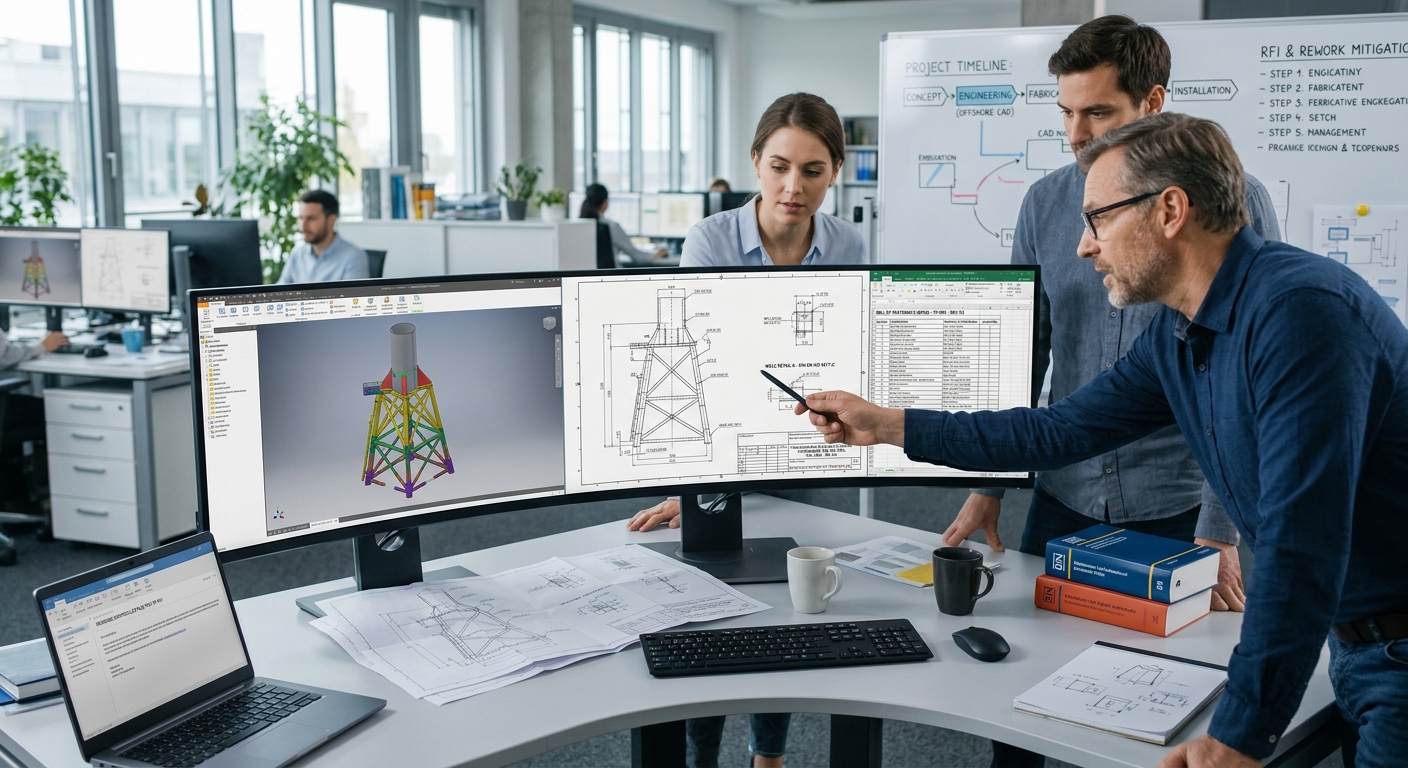
Offshore projects run on documentation as much as steel. Here's what a CAD team actually delivers, and where it fits into your project timeline.
The role, in plain terms
An offshore CAD team turns engineering intent into manufacturable, reviewable, and traceable documentation. That covers 3D models, 2D drawings, bills of materials, and revision-controlled files that a fabricator, installer, or classification society can act on without guessing.
It is easy to underestimate how much of an offshore project's timeline is documentation, not steel. A foundation or platform that is structurally sound but poorly documented still delays fabrication, invites RFIs, and creates rework. The CAD team's job is to prevent exactly that.
Core deliverables
A competent offshore CAD team typically delivers three layers of output. First, 3D parametric models — not static geometry, but models that update correctly when a dimension or material changes, so revisions do not mean starting over.
Second, 2D manufacturing drawings with full dimensioning, tolerances, and welding or assembly notes — the documents a workshop actually builds from. Third, supporting documentation: bills of materials, material take-offs, and revision histories that keep procurement, fabrication, and QA aligned on exactly which version is current.
Where standards come in
Offshore work is standards-heavy — DIN, EN, and project-specific specifications all shape how a drawing is dimensioned, toleranced, and annotated. A CAD team working across German and international standards needs to interpret those requirements correctly the first time, not after a rejected drawing set costs a week.
This is where European-trained engineering backgrounds tend to matter in practice: reading a DIN callout correctly, or knowing what an EN standard actually requires in terms of weld detailing, is not something a drafting-only service typically covers.
How it fits into the project timeline
CAD work usually sits between concept design and fabrication. The team takes structural or process engineering input and converts it into a documentation package that fabrication can quote, procure against, and build from — while staying open to design review and optimisation passes before anything is locked.
On offshore wind and structural steel projects specifically, this stage also involves coordination-ready models — files structured so other disciplines (structural, electrical, installation planning) can work from the same source without conflicting versions.
When to bring in a specialist team
Not every project needs a dedicated offshore CAD team. A single component or a one-off drawing might be handled in-house. But once a project involves multiple revisions, cross-discipline coordination, or documentation that has to survive a classification review, a specialist team pays for itself in avoided rework alone.
Through OffshoreCAD, its CAD and drafting division, Baron Engineering Group provides exactly this: German-trained mechanical design engineering for offshore, onshore, and industrial projects, from a single technical drawing to a full CAD documentation package.
Need this on your project?
Mechanical and structural engineering led by a Chartered Professional Engineer (CPEng), Engineers Australia, with 3D and 2D CAD design delivered through OffshoreCAD, our CAD division.

